Reading: municipal bus services at the heart of city life
Where?
Reading, South East England
What has been achieved?
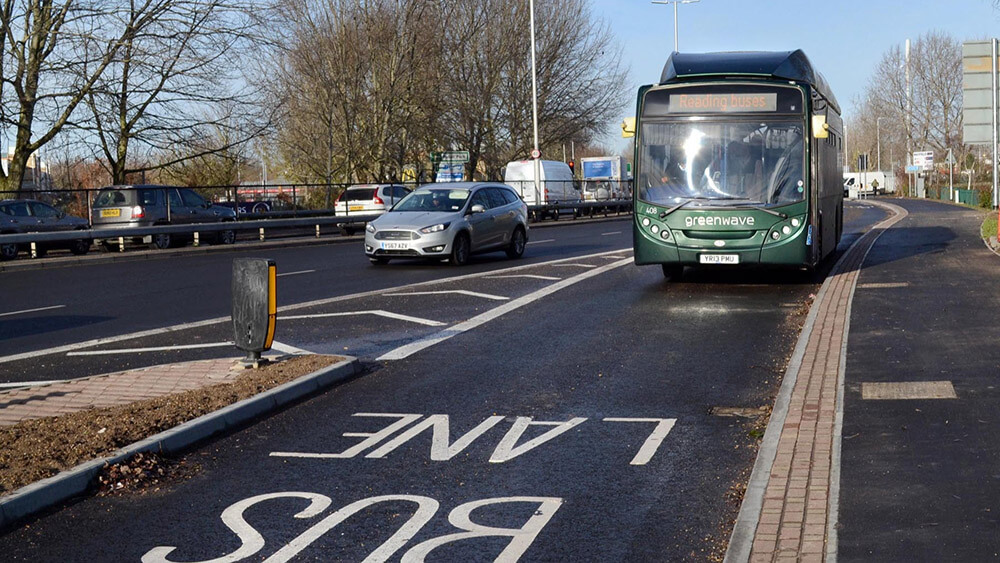
Reading Buses is one of only five municipal bus companies remaining in England. With nippy bus lanes, low-carbon buses, and the third-highest bus use per head in England, Reading is a success story that could provide lessons for other areas looking to use the powers in the new Buses Bill.
What are municipal bus companies?
Across England, the overwhelming majority of bus services have been delivered by private operators since deregulation in 1986. Local authorities can still be involved in planning and coordinating provision through enhanced partnerships with operators. Prior to that, local authorities were allowed to create municipal bus companies, where they own and run their own buses. This has been banned in recent years, but those which existed at the time of privatisation were allowed to remain. Five currently still exist in Blackpool, Ipswich, Nottingham, Reading and Warrington. There are also two in Wales and two in Scotland. These still remain open to competition from private bus operators, so do not function as a local monopoly.
In September 2024 the Government introduced a Buses Bill which will reverse the ban on setting up new publicly owned bus companies.
Reading Buses’ successes
Reading’s municipal bus company – Reading Buses – has received recognition and awards for its commitment to providing high-quality, environmentally friendly, and affordable public transport. The council-owned company has been an integral part of Reading’s approach to tackling traffic congestion, reducing greenhouse gas emissions, and improving air quality, in line with its transport strategy – ensuring political buy-in.
Through substantial investment in infrastructure and bus fleet, Reading has created one of the most successful public transport networks in the UK outside London.
Indeed, Reading has the third highest bus use per head across England outside London after Brighton & Hove and Nottingham, despite a drop post-pandemic. The £2 national fares cap has helped drive ridership back up, supplementing Reading’s pre-existing daily travel tickets.
Reading Buses are also a source of civic pride due to their diverse and colourful fleet, signifying various routes. ‘The Purple 17’, considered the backbone of Reading, is a local institution.
Key initiatives
The following key initiatives have helped Reading achieve its success:
Bus Rapid Transit (BRT) Project
Since 2014, £30 million has been invested in the South Reading Bus Rapid Transit project. The objectives were to reduce journey times along the A33 corridor, to enhance the reliability and desirability of bus use, to connect key employment sites, and to improve urban connectivity. It also planned to mitigate transport-related emissions and improve air quality. The project was delivered in several phases and included additional bus lanes, bus priority at junctions, enforcement cameras and new bus stops.
BSIP Investment
Reading successfully bid for Bus Service Improvement Plan (BSIP) funding in 2022 and received over £26 million. Around £16m of this is earmarked for bus infrastructure enhancement, and £10m for bus service improvements. The funding is currently being used for:
- Further investment on key bus corridors and new routes
- Simpler fares and integrated ticketing across all modes of local transport
- Significant increases in bus priority and new bus lanes, including a new phase of the South Reading Bus Rapid Transit project
- Further decarbonisation of Reading’s bus fleet
Bus fleet investment
Reading Buses also invested in bio-gas powered buses, significantly reducing CO2 emissions and promoting a quieter, cleaner, and greener fleet. The adoption of bio-gas powered buses and the emphasis on greener alternatives has led to significant reductions in CO2 emissions compared to diesel buses. The investment in a quieter, cleaner, and greener fleet has contributed to mitigating the environmental impact of public transport.
The company also explored electrification options for the fleet to further enhance environmental benefits, with a trial in 2021. Thanks to securing additional government funding, the council is now investing in 24 new electric buses.
Challenges
Overall, the investment and prioritisation of bus improvement continue. In January 2024 the Traffic Management Sub-Committee voted to implement new bus lanes on arterial routes in and out of the town centre.
However, this is not always without controversy, and challenges exist. For example:
- Prevailing national transport policies that make private car journeys relatively cheaper compared to public transport
- Financial difficulties due to inflationary pressure
- A deregulated bus market and a privatised railway system, adding complexity to strategic planning and service integration
- The pandemic-induced drop in passenger numbers and changes in travel habits as numbers have not yet recovered post-lockdown
- Some local opposition which underscores the importance of local consultation.
Overall, Reading’s proactive approach to investing in sustainable public transport infrastructure and services demonstrates a commitment to addressing environmental challenges, reducing carbon emissions, improving air quality, and promoting access to public transport. These efforts have positioned Reading as a leader in sustainable urban mobility and provide valuable lessons for other local authorities to follow.
What next for municipal bus companies?
While councils can still buy existing bus operators, the Bus Service Act 2017 banned councils from setting up bus companies from scratch, something Scotland and Wales have overturned. In the 2021 National Bus Strategy, Bus Back Better, the previous government committed to remove the ban in England, yet this had not happened before the 2024 general election. In September 2024, the new Labour Government introduced a Buses Bill which will reverse the ban on setting up new publicly owned bus companies as well as extending the ability to franchise local bus services to all local authorities that want it. It remains to be seen how many authorities will take advantage of these powers.