Time for Trams side-by-side series: Bordeaux and Hull
Bordeaux's trams have improved the city's air quality, made streets more walkable, and supported new growth corridors. Is it time for trams in Hull?

A tram in Bordeaux
Two port cities of a similar size, replete with historic buildings. But while four tram lines keep Bordeaux moving, Hull lost its trams in the 1940s.
With 21st-Century trams bringing such enormous benefits to Bordeaux, is it time for trams to run through Hull once more?
Read our comparison and make your own mind up…
Bordeaux
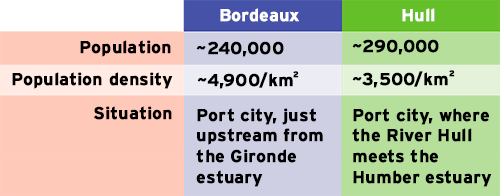
Population: 241,287 (2025 est.)
Population density: 4,888/km2
Background
Bordeaux is one of France’s main seaports, built on the Garonne River near the foot of the estuary. With a population of ~240,000 and population density of ~4,900km2, it ranks as the 9th largest city in France. Many of the historic buildings present in Bordeaux sprung up around the Age of Enlightenment in the 18th Century and the city centre now has World Heritage status. Bordeaux has a history as a port involved in the production, sale, and distribution of wine, alongside metals and textiles. Nowadays, Bordeaux is a hub for the aeronautics, military and space sector, alongside having a strong gastronomy pull.
Introducing trams
Alain Juppé, the Mayor of Bordeaux in 1995, championed the city tram network at a time of immense transport problems. The Bordeaux Metropole adopted the tram plan in 1997. The first line of the modern tramway opened in December 2003 and by 2005, the initial phase was complete – three lines crossing the city centre. The system now has 4 lines (A, B, C, D) and a total length of 77.5km, serving 133 stops.
Overcoming overhead wires
A ground-level power supply system in centre of Bordeaux removes the need for overhead wires. Instead there is a central rail that is only live when the tram is directly over it.
There were worries that the overhead wires would threaten the integrity of the UNESCO world heritage site. The Bordeaux tram system is innovative, without overhead cables for significant portions of the network. This is made possible by a ground-level power supply system in the city centre regions, requested by the Bordeaux Metropole, that removes the need for overhead wires and supplies the tram through a central rail that is only live when the tram is directly over it.
Funding
The public transport system is called Transports Bordeaux Métropole, integrating trams with 75 bus routes which stop running at 1am. The tramway and bus costs €1.50 per trip regardless of distance. 165,000 daily journeys are made by tram but the overall transport system sees some 300,000 passenger journeys a day. Bordeaux has increased its Versement Transport tax, a local contribution payable by employers with more than 11 employees, to 2% of the payroll costs of each employer. In total, 82% of its first three tramlines were funded locally.
Wider benefits
Trams in Bordeaux have been creating more walkable streets. Trams generally attract more usage than buses, creating diesel free environments. The tram has had a huge role in defining new growth corridors and increasing the predictability of transport in the city. Trams have also been engineered as sociable spaces with their smooth running and open arrangement of seats.

Hull
Population: 289,602 (2025 est.)
Population density: 3,486/km2
Background
Like Bordeaux, Hull is a port city, built on the bank of the Humber estuary where it joins the River Hull. In 2019, both cities welcomed around 6.8 million visitors / tourists. With a population of ~290,000 and population density of ~3,500km2, it ranks as the 29th biggest city in the UK. The earliest buildings date back to the 17th century, with the city demonstrating a true fusion of architectural styles from Victorian / Edwardian through to Gothic. Hull has an industrial heritage in exporting wool and textiles, and importing wine and timber. Now Hull has a manufacturing, engineering, and assembly industry, aided by its port infrastructure, alongside a growing renewables sector.
Trams in days gone by
Hull is a city that has been marked by the former existence of trams. In the 1920s, tram expansion led to Hull’s main roads starting to develop into dual carriageways with a broad green space between the lanes where the trams would run. Spring Bank West, Beverley Road, and Holderness Road are examples. Trolleybuses quickly replaced trams by the 1940s.
How might a modern tram system work?
A 2014 BBC Humber forum uncovered a range of views on integrating trams with the existing transport system. Major rail lines run out of Paragon Station to the west which means the east of the city is less connected to the operational railway. However, lines east of Paragon station do exist and could become core lines of a new tram system for Hull.
The Hull and Barnsley Railway goods line could be harnessed to link Paragon station with the Withernsea railbed at Southcoates, and the Hornsea railbed at the H&B embankment. This H&B line also crosses every major road in the city, providing valuable interchange points for a tram system. The track by the docks is also little used so could be used to operate a tram (much like the Tyne and Wear Metro which made use of existing infrastructure). There is also a possibility for a tram connection out of platforms 13/14 at Paragon Station onto Anlaby Road, Carr Lane, and then through the city centre.
Overcoming concerns
The time taken to rebuild the bus station in Hull, alongside bus failures in the past, has lessened confidence in politicians delivering on trams. Funding for the nearby Leeds tram has also taken too long from the Government. There are congestion worries from the building of tram lines, alongside the potential traffic caused by crossing trams on major roads. Overpriced trams would be undesirable. The tram system must also extend to residential areas.
The existing Hull and Barnsley line is grade separated meaning that if trams were to run up and down with passing places, interference with the road network would be minimised. Buses could be integrated with the tram network in such a way that they serve major crossover points. If the tram was extended to Priory Park and Ride, or a new park and ride terminus was created, then this would reduce the load on buses and further reduce the need for buses and cars to enter the city centre, relieving congestion and creating more walkable streets. An established tram network to supplement bus services would assist in persuading vehicle users to leave their cars at home or outside the city. Hull can learn from Bordeaux and the French system which uses tax obtained from the Versement Transport to operate its tram system.
Is it time for trams in YOUR town?
Would your town or city like a tram? Tram Network can help.
Led by Campaign for Better Transport and Create Streets, supported by an advisory board of senior industry leaders and engineering and implementation experts from the transport industry, we can visit, advise and support you.
Find out more about Tram Network
Photo above: David McKelvey via Flickr, CC BY-NC-ND 2.0


