Time for Trams side-by-side series: Dijon and Oxford
Trams work wonderfully in Dijon – how about Oxford?
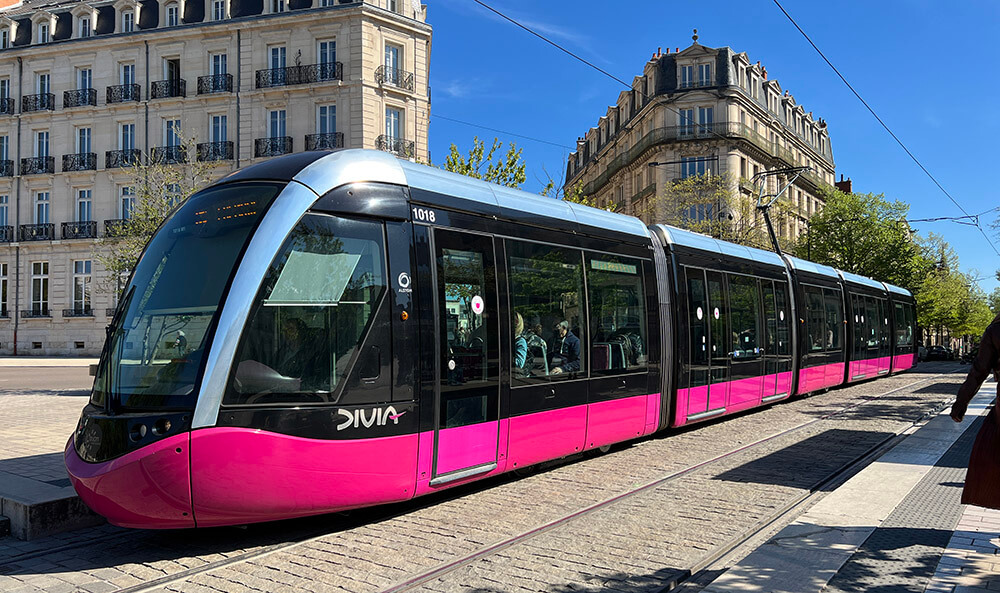
A tram in Dijon
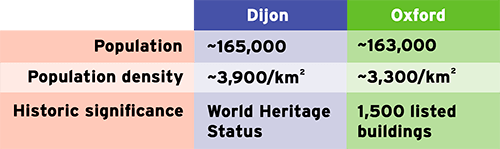
Two historic cities, the same size and density… but only one of them has trams!
Dijon’s massively successful tram network has helped cut private car usage significantly.
Is it time for trams in Oxford? Read our comparison and make your own mind up…
Dijon
Population: 165,057 (2025 est.)
Population density: 3,949/km2
Background
Dijon is built on the confluence of the Ouche and Suzon rivers. With a population of ~165,000 and population density of ~3,900/km2, it ranks as the 18th biggest city in France. The earliest buildings date back to the 13th century and the centre of Dijon gained world heritage status in 2015 for its late medieval and renaissance architecture. Dijon has a history in wine production as the capital of Burgundy, and more recently has become a hub for gastronomy and mechanical engineering industries.
Implementing trams in Dijon
On 28 November 2024, then-Transport Secretary Louise Haigh used Dijon as a model for UK cities with a population of 150,000+ to aspire towards in her unveiling of a national integrated transport system. Dijon is among the most recent of the 20+ towns and cities that have reintroduced trams over the last 40 years.
The modern Dijon tram network opened in 2012 after a lengthy process of restructuring their transport system which began in the 1970s. Higher-capacity bus lines struggling to cope with demand in the 2000s pointed to the need for major investment in tram infrastructure. Crucially, Dijon’s method involved addressing their existing transport system first rather than steamrolling through with tram investment as the ‘obvious’ solution if buses are falling short of capacity. Addressing the existing system created the need for higher capacity light rail operations.
Investment then came and was well thought through, with a joint Alstom tram order with Brest reporting a 25% discount. Funding for the initial 399M project was secured in 2009, a year after political approval was granted, and a year before construction began. The bulk came from a loan from the European Investment Bank with the remainder coming from the French Government, Burgundy Region, and the local Côte-d’Or département. The tramway was constructed through a public-private partnership between the Grand Dijon urban district and equipment manufacturer and controller Cofely Ineo.
Funding
The transport network is run by a single private company, Keolis Dijon Multimodalité, who manage everything transport related, from trams, bicycles, and buses, to car parks and transport for disabled people. They also operate the Docklands Light Railway in London and Tramlink in Nottingham. Only quarter of the system is funded by the fares – a flat rate of €1.40 for a bus or tram ride, operated by on-board card payment, and €1 for hiring a bike for an hour . Half of the cost of running the system is provided by the Versement Transport levy on all local businesses that employ more than 11 people, that by law they have a responsibility to invest in local transport infrastructure. The remaining quarter is provided by the local authority.
Integration
The tram system is well linked with buses in Dijon – a reconfigured bus service upon the introduction of the modern tramway connects neighbourhoods and park and ride facilities to the tram and city, with free electric shuttle buses feeding the tram in the city centre. The cycle network has also been configured around the tramline, with segregated lanes and over 40 stations around the city to take out and dock bikes.
Journey times on the T1 from end to end are 7 minutes faster than the previous bus service. Journey times on the T2 are almost 20 minutes faster than the former bus service.
Ridership
Annual ridership of the Dijon tramway is around 24 million passengers per year, giving 2 million riders per km per annum – compared to UK examples, Croydon has 0.8 million passengers per km per annum, and Nottingham has 0.5 million. Thirty-four per cent of tram stops serve major traffic generators, falling under education, transport hubs, health, recreation and culture. This ensures that the tram remains a viable and preferred option, with private car usage falling significantly.
Bus and tram journeys have increased by 40% in Dijon, and private car use is falling.

Oxford
Population: 162,596 (2025 est.)
Population density: 3,270/km2
Background
Oxford is built on the confluence of the Thames and Cherwell rivers. With a population of ~163,000 and population density of ~3,300km2, it ranks as the 69th biggest city in the UK. The earliest buildings date back to the 11th century and the centre of Oxford is characterised by Gothic and Baroque architecture of the many colleges and establishments. Like Dijon, Oxford has a history in the alcohol industry with malting and brewing in the city backdating to the 16th century. Oxford has long been shaped by its academic history and, more recently, the development of car manufacturing.
Oxford’s battle with the tram
Since the fall of the early tramway in 1914 with the introduction of the Oxford Motor Omnibus Company by William Morris, Oxford have relied on buses to fulfil their public transport quota and their development as a modern city.
The aesthetic issue of overhead cables has long plagued Oxford’s tram debate. Dijon too went through similar debates and uncertainties leading up to building their network. Dijon trams operate via overhead cables, but you don’t have to look far to see the successes of the ground powered tram systems in Bordeaux and Nice. Oxford’s streets could certainly exist with 2-3 tram lines, much like Dijon, but with buses having a monopoly in Oxford, the system would require a similar restructuring, alongside a plan for funding infrastructure and maintaining running costs.
City structure
Oxford has a highly linear structure, with just a few major road corridors facilitating the majority of movement through the city centre to neighbourhoods. Even if trams were to be introduced on the two routes of old, one running from east to west along Cowley Road to the Station and the other running from north to south, down Banbury Road and Abingdon Road, intersecting at Carfax Tower, it is easy to see that they would serve excellent coverage. Introducing a third route along Headington Road would further increase neighbourhood accessibility to the tramway, providing that bus networks were repurposed as Dijon style ‘feeder’ systems for the tram and not run in direct competition.
Previous tram exploration
A future with trams in Oxford has been explored for over 10 years. Images were released as early as 2014 by Oxfordshire County Council of ground powered mass transit systems in St Giles and London Oxford Airport . The URBED Trams for Oxford study to explore the feasibility of trams in Oxford highlighted some key conclusions.
- Buses will compete with trams in Oxford, unless an integrated system can be introduced. This may resemble high frequency trams, buses in lower density areas, and optimising the use of bicycles in association with public transport routes.
- The importance of making a case for the real objective which is to reduce congestion and the impact of the car. This may allow for successful expansion of Oxford’s Zero Emissions Zone. Reducing buses in the city centre will also contribute to a cleaner ZEZ.
- Benchmarking against cities in Europe. There is a lot to be learnt from the French attitude to transport which has greater focus on its regeneration benefits and impact on city image. Innovative French-style design and procurement will allow Oxford to cut instalment costs and boost the vibrancy of its city centre.
- Trams offer benefits over segregated bus lanes in historic cities. Keeping to guided routes and taking up less road space than buses, trams allow people to used shared areas with little conflict. Trams are more predictable than buses for visitors and are also faster, with trams in Dijon reducing times on the equivalent bus routes by up to 40%.
Bus capacity and traffic
Oxford’s bus capacity is struggling. Councillor Louise Upton, Cabinet Member for Planning, released this statement on 3 February 2025:
“The county council needs to sit down with the bus companies, businesses and others urgently to find solutions. All options must be on the table.”
In November 2024, 74% of survey respondents said that congestion within the city had worsened. In the words of Oxfordshire Liveable Streets:
“The population in and around Oxford is going to rise 20% by 2029. It’s common sense that with this growth, we can’t all drive everywhere at the same times of day. To keep our city moving 1 in 4 car journeys need to change.”
What about a levy?
Half of the operating and maintenance costs of the Dijon transport network, including the tram system, is funded by a business levy called the Versement Transport, making public transport funding for all businesses of over 11 people a legal obligation.
Oxford are currently next in line in the UK to secure what is called a Workplace Parking Levy – a similar system which taxes employers on their car parking spaces. The city is looking to gain approval from the DfT in Spring 2027. The importance of making a successful business case for a Workplace Parking Levy was crucial in its passing in the case of Nottingham Tramlink. Congestion in Nottingham was estimated to cost £160 million a year with half of that borne by businesses. The levy was also a more attractive prospect for the council, guaranteeing a revenue stream with relatively low set up costs and being cheaper to run than clean air zones.
Is it time for trams in YOUR town?
Would your town or city like a tram? Tram Network can help.
Led by Campaign for Better Transport and Create Streets, supported by an advisory board of senior industry leaders and engineering and implementation experts from the transport industry, we can visit, advise and support you.
Find out more about Tram Network
Photo above: Chabe01 via Wikimedia Commons, CC BY-SA 4.0


