Time for Trams side-by-side series: Montpellier and Bournemouth / Christchurch / Poole
The seaside town of Montpellier has brought back trams! With Bournemouth, Christchurch and Poole suffering traffic chaos, is it time for them to do the same?

A tram in Montpellier
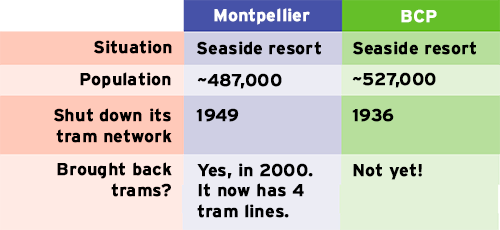
Two seaside resorts…
Both shut down their tram networks in the mid 20th Century…
But while Bournemouth/Christchurch/Poole still has no trams, Montpellier has brought them back – with resounding success!
Is it time for Bournemouth/Christchurch/Poole to do the same? Read our comparison and make your own mind up…
Montpellier
Population: 486,923 (2025 est.)
Population density: 4,460/km2
Background
Montpellier is a seaside resort on the south coast of France. With a population of ~487,000 and population density of ~4,500km2, it ranks as the 7th biggest city in France and the 3rd biggest French city on the Mediterranean coast. The earliest buildings date back to the 12th century and much of Montpellier’s current elegance sprang up in the 17th Century, including the citadel. Montpellier also has a large contemporary and neo-classical influence, led by some of the most innovative architects in the world. Industry in Montpellier originally sprung from its world-renowned Faculty of Medicine, now with leading scientific industries in agriculture, food, pharmaceuticals, biodiversity, and the environment.
In come the trams!
In 2000, Montpellier opened the first of now four tramlines, 51 years after abandoning its first tramway network. Prior to trams, the transport network, solely reliant on buses, was very overstretched. Despite efforts to develop bus infrastructure, such as building a section of two-lane busway, network-wide average bus speed was only around 14km/h in the mid 1990s and in central zones, as low as 7km/h.
Redesigning the transport system
Introducing light rail required the traffic network in the central area to be redesigned. As a result, only a handful of buses are now allowed to enter the central area. Replacing a greater number of buses with a smaller number of high-capacity trams has reduced the noise, air pollution, congestion, and operating costs. Addressing the climate crisis by encouraging greener transport and reducing the cost of living were two main motivators for implementing the scheme, potentially saving a family of four €1,470 per year.
Montpellier has four tram lines, serving a total of 84 stations on 56km of track. The lines have been well designed to serve major traffic generators, including the Odysseum shopping mall, arts centre, historic district and Euromédicine business park, linking them with older and newer neighbourhoods. By granting the tram an exclusive right of way and high priority at traffic signals, the District made the tramway the fastest mode in the city.
Ensuring that supplementary bus services are well used gives the tramway a substantial ‘base’ load of people, supporting frequent services. Tram-bus interchanges and provision of car and bike parking at tram stations has encouraged modal transfer and promoted use. Aesthetic design of stations, street furniture, and tram exteriors have boosted the quality of the urban environment, with trams boosting the comfort of journeys and assisting with economic development along the route.
Free transport for residents
Montpellier has made public transport free for its residents, increasing usage by a third.
In December 2023, Montpellier made public transport free of charge to all residents, which saw usage increase by a third – up from 84 million trips in 2019 to 110 million in 2024. This decision-making process was incremental – in 2020 it was free at weekends and in 2021 it became free for under-18s and over 65s. Now Montpellier is the biggest city in Europe to introduce such a measure. Only residents can sign up, providing photo ID and proof of address in exchange for a free transport pass. The pass must be scanned on every journey so the city can track usage.
Funding for the future
Transport is funded through three main channels:
- Commercial revenue from non-residents through ticket sales
- Imposing a transport tax on employers with 11 employees or more, making it a legal requirement for them to contribute to funding transport and mobility services
- Public funding from local authorities.
A successful investment strategy will continue to fuel the growth of the city’s transport network. Montpellier has a plan to invest €1 billion over six years in public transport, alongside cycle lanes and car-pooling schemes.

Bournemouth, Christchurch and Poole (BCP)
Population: 526,845 (2025 est.)
Population density: 3,272/km2
Traffic congestion is a big problem in Bournemouth, Christchurch and Poole. On average two and a half full days are lost every year when travelling at rush hour.
Background
Bournemouth, Christchurch and Poole is a seaside resort on the south coast of England. With a population of ~527,000 and population density of ~3,300km2, it ranks as the eighth biggest conurbation in the UK and the second biggest on the south coast. BCP largely sprung up in the 19th Century and is now dominated by Victorian architecture. The conurbation originally grew as a spa town retreat with a large network of hotels and residencies. Nowadays, tourism industries thrive in the summer months and there is a growing financial industry.
A city built on the tram
Once upon a time, BCP had a roaring and successful tram network. The Bournemouth Corporation Tramways used to extend from Poole to Christchurch. The fleet of 115 was still going strong in 1936 when the system was closed in favour of trolleybuses which had lower running and maintenance costs than trams.
Buses in Bournemouth
Buses in Bournemouth have struggled in recent years. Yellow Buses Bournemouth fell into administration in 2022. In July 2023, the council cut several major routes that were due to see additional bus and cycle lanes, including Boundary Road to Redhill Avenue and Broadway Lane linking up to Parley Lane by Bournemouth Airport.
Time for trams?
Traffic chaos still plagues the streets today – on average two and a half full days are lost every year when travelling at rush hour.
As Bournemouth rethinks its sustainable transport strategy, it could prove a perfect time to implement trams. For example, a nine- to ten-km line, originating from the town centre, to link key traffic generators including Wessex Fields science and technology park, the airport, Vitality Stadium, Littledown leisure facility, and Lansdowne, presents a huge opportunity to reduce congestion and increase transit times.
The potential of utilising the mainline between Poole and Christchurch with a branch to Bournemouth, is an opportunity for implementing a tram service. Trams could also replace the congested Poole to Christchurch bus corridor, and replace or subsidise the existing infrequent and inconvenient bus services to the expanding Bournemouth Airport.
The new Western Gateway Strategic Investment Plan 2025-2035 includes the Dorset Metro Shuttle within its top three priority proposals for ‘sustainable growth and economy’ and ‘access to services and opportunities’ . This looks to add an additional train per hour from Wareham to Brockenhurst, via Poole and Bournemouth which will boost rail connectivity by increasing the accessibility of BCP with its surrounding towns. There is huge potential for this scheme to be linked with a tram system which would bring neighbourhoods and local landmarks closer to the mainline.
Is it time for trams in YOUR town?
Would your town or city like a tram? Tram Network can help.
Led by Campaign for Better Transport and Create Streets, supported by an advisory board of senior industry leaders and engineering and implementation experts from the transport industry, we can visit, advise and support you.


