Campaign for Better Transport – A history
This is a guest blog by Stephen Joseph, Director of Campaign for Better Transport 1988-2019.
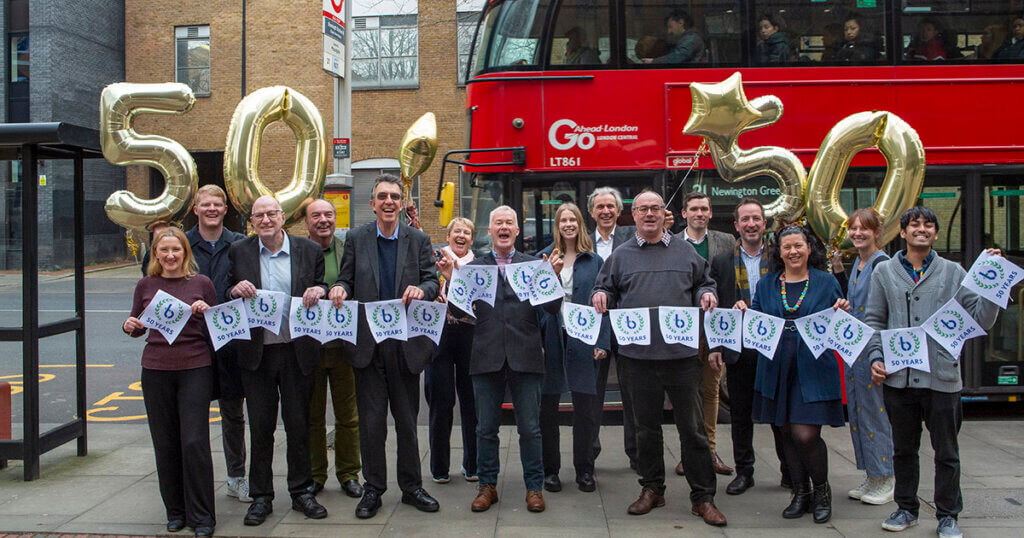
The context in which Campaign for Better Transport’s predecessor, Transport 2000, was formed 50 years ago, in 1973, was different from today. The immediate trigger for creating an unusual and broad-based alliance was the leaking to the Railway Gazette and the Sunday Times of a secret plan drawn up by Government officials to close down most of the British railway network, halving it from around 11,000 route miles to 5,000, or possibly even less. Most lines in Scotland, Wales, Cornwall and East Anglia would have been shut, with substantial cuts elsewhere.
It was this that led to the creation of Transport 2000. The then deputy general secretary of the NUR, Sidney Weighell, realised that the unions couldn’t win the fight against these cuts on their own and worked with environmental groups, notably the Civic Trust, the Conservation Society and the Council for the Preservation of Rural England (CPRE) to create the organisation. Crucial to it being a broad church was that, although the funding for it came from the unions, it was not their creature. The direction was provided by the amenity groups and others; the first chair was a Liberal called Eric Robinson and the organisation was based at the Railway Industry Association, whose director Michael Harris provided the secretariat.
As well as the railway cuts, the prevailing policy at the time was to build more roads, in cities as well as between them. In the early 1970s there were major plans for urban motorways. In fact, I was told that the name Transport 2000 was inspired by York 2000, a group set up to oppose an inner relief road which would have demolished much of the medieval city wall and other old buildings. The Greater London Council was pursuing a plan for three ‘ringways’, including an inner ring which would have demolished many inner London suburbs.
The plans were pursued by a strongly pro-road Ministry of Transport (at the time merged into the Department of the Environment). Officials saw their role as promoting road haulage and road and air transport; they thought of railways as a 19th century hangover that should be got rid of and certainly should get no public funding. In this they were supported by a powerful road lobby of freight industry, motor manufacturers, oil companies and construction forms, which came together as the British Road Federation (BRF). Politicians of all parties shared this view – one of the most anti-rail Environment Secretaries was Labour’s Anthony Crosland, who saw railways as over subsidised and the opponents of roads “trying to pull the ladder of car ownership up behind them”.
Transport 2000 was the first real challenge to this world view, since it came with real funding and created a coalition to oppose the BRF’s. This was augmented when British Rail joined it and – much to the civil servants’ fury – funded it from 1978. This allowed Transport 2000 to employ its own staff – Mick Hamer as director (who came to it from being Friends of the Earth’s transport campaigner) and Nick Lester, who had helped create the London Cycling Campaign.
There were various highlights from these early years – one was a leaked document from an official at the Ministry of Transport on increasing the maximum weight and size of trucks allowed in the UK, which proposed setting up a supposedly independent commission “which would come to a decision in line with the Department’s views”. This caused a lot of public anger – but the commission was set up and duly reported in favour of increasing the maximum weight limit to 44 tonnes. Opposition to road building grew – there were sit-ins at public inquiries (I was in one), to protest at their undemocratic nature. Transport 2000 helped co-ordinate these, and some of the most damaging were stopped. Pro-public transport policies were instituted by the GLC and its equivalents in other cities – the South Yorkshire 2p bus fare is still fondly remembered – but faced opposition from the Conservative Government, which wanted to get back to building roads and hated the GLC’s ‘fares fair’ policy. Nick Lester and a later Transport 2000 director Keith Buchan went to the GLC, in particular to help create a night-time ban on heavy lorries in London (which still exists).
So Transport 2000 found itself facing further threats – a new attempt to shut most of the rail network, from a 1983 review led by a former civil servant Sir David Serpell (only 1600 miles would be left under one review option) was seen off, with a lot of campaigning and research (the then assistant director Jonathan Roberts did detailed work on this), but the Government did succeed in deregulating buses in 1986 and abolishing the GLC and the metropolitan councils. Transport 2000’s then director, Susan Hoyle helped set up Buswatch to allow users to show what was happening to their bus services as a result of the deregulation and privatisation. At the same time, there was a deregulation of the planning system, leading to a rash of out-of-town car-based developments.
The Government had one last go at major rail closures, with a plan to shut the Settle-Carlisle line. This led to a huge campaign, which many Transport 2000 activists were involved in, and which was eventually successful. At the same time, in 1989 the Government launched “the biggest roads programme since the Romans”, under the title Roads for Prosperity, and alongside this launched new ‘assessment studies’ in London to revive some of the previous ringways plan. All this created a new wave of campaigning – the London studies resulted in ALARM London a federation of anti-road groups which became ALARM UK. There were protests at Twyford Down and elsewhere against major roads – and eventually the programme was scaled back. There was increasing environmental awareness and also new technical work from an advisory committee, SACTRA, showing that building new rods generated traffic and didn’t solve congestion.
I became director of Transport 2000 in September 1988 and I and the three other staff (it was a small organisation then) had to respond to all of this. We created a Transport Roundtable (TAR) of the environmental groups opposed to road building and supported ALARM UK in various ways. When the Government brought forward rail privatisation, we created another coalition, Platform for Better Rail Services, which didn’t stop privatisation but did get various safeguards (through tickets, etc) built in. We expanded the organisation by creating a charitable trust, which widened our potential funding sources. Hostility from the civil service was gradually tempered as we used the trust to promote new research on tackling transport issues. This helped when Labour took power in 1997; we had helped thinking among Labour policy makers on what they might do, including a review of the roads programme and a White Paper on transport policy and a subsequent Transport Act.
One notable Transport 2000 success at this time – perhaps the most far-reaching in practice – was the reform of company car taxation, from a system which rewarded gas guzzlers and high mileage to one that rewarded lower carbon emissions. This changed business travel culture at the time (and was said by one researcher to have increased rail use among businessmen). This came from a ‘transport taxation group’ that Transport 2000 ran for many years – this also succeeded in developing what became a Workplace Parking Levy, adopted by Nottingham City Council.
There were other developments. From 1988, when Susan Hoyle and Judith Hanna, then Assistant Director, set up Feet First to promote pedestrian priority schemes, the organisation promoted active travel and redesign of streets, and was part of the Slower Speeds Initiative. It set up Freight on Rail, to promote rail freight (another joint initiative with the rail unions). It was instrumental in setting up the European Federation for Transport & Environment, T&E, which is now a powerful lobby group in Brussels. It co-ordinated a Local Transport Day to help communities lobby their councils for better local transport planning. It helped a Scottish sister body – Transform Scotland – set up, in 1997. However, it became apparent as the year 2000 came and went that the organisation did need to change its name, and eventually, after some false starts, it became Campaign for Better Transport in 2007.
The last decade saw a return to road building, but also a huge growth in rail use (until the Covid pandemic) and some successes – we ran a campaign to get new trains in the North of England, replacing the old ‘pacers’, some rail lines have been reopened, and there was the Local Sustainable Transport Fund, which funded a lot of local projects across England (the Minister behind this, Norman Baker, is now Campaign for Better Transport’s director of external Affairs. More recently there has been some new funding for buses and active travel, some rail lines have finally been electrified and Crossrail (envisaged in a 1989 Central London Rail Study, soon after I started as Transport 2000 Director) has opened. Trams – which had disappeared completely from the UK apart from in Blackpool – have reappeared on city streets.
So has Campaign for Better Transport succeeded? In some ways things have changed – cities are cutting traffic not building roads, and railways and trams are being opened not closed. But in some ways, things haven’t changed – budget cuts this year seem likely to hit all public transport, with severe bus cuts and rail service cutbacks. Major roads are still being built, backed by dodgy appraisal and modelling; the UK is still very car dependent with expensive public transport, cheap air fares and a transport tax system needing reform. Above all, the challenge of tackling climate change – where transport is the biggest polluter – is being ducked. But I think Campaign for Better Transport has made a difference, by being a voice for change, backed by solid research and an ability to create coalitions to support transport reforms. An array of very talented people have worked for it over the years, or been on its board or in its local groups, and have gone on to champion sustainable transport elsewhere.
Hopefully Campaign for Better Transport will survive and prosper. It still has a lot of work to do!


