From London to Portugal by train: what I learnt about transport and climate
When asked to present our archive to sustainability experts in Coimbra, Portugal, Michael decided to get there by train, learning and sharing lessons about transport and climate along the way.
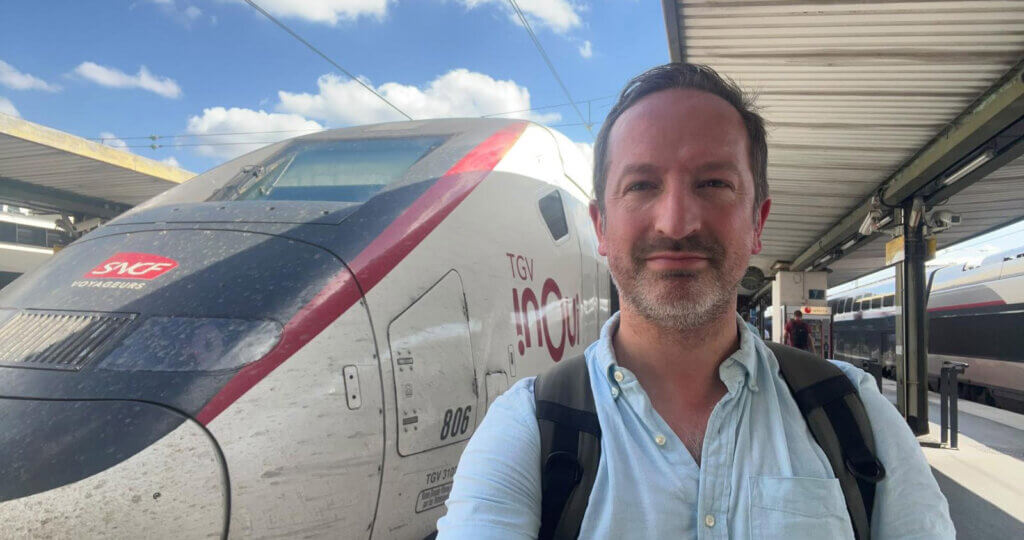
We are very lucky at Campaign for Better Transport to have an extraordinary archive of more than half a century of campaigning, now catalogued and available to the public at the National Railway Museum. It is a remarkable resource, documenting our work on everything from rail reopenings and bus services to trams, ticketing and integrated transport.
That history feels particularly relevant today. As the Government embarks on major transport reform, we have a proud record to build on – while one issue now hangs over all of it: the climate emergency.
So when the National Railway Museum asked if I would travel to Coimbra, the former medieval capital of Portugal, to present our archive to an audience of sustainability archivists, it was a thought-provoking invitation. It wasn’t, however, an entirely realistic journey for a busy campaigner.
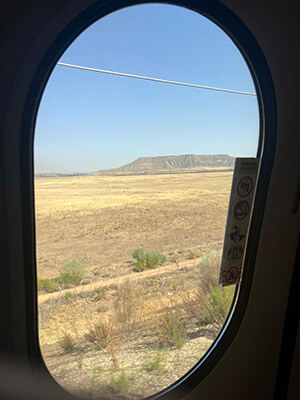 Until an idea occurred to me: why not turn the journey itself into a campaign?
We could present our archive while making the journey part of the archive, demonstrating what international rail can offer and sharing what countries along the way are doing to tackle climate change through better transport. Rail industry colleagues were enthusiastic, and Eurostar and Getlink came on board to support the trip. It was a brilliant opportunity to showcase our work while making the case for international rail.
Our international rail campaign is more important than ever. Eurostar’s figures show that travelling by high-speed rail between London and Paris produces around 97% fewer emissions than flying. If we are serious about tackling transport emissions, Government should do everything within its power to make international rail the natural choice wherever it can compete with aviation.
There is plenty to be encouraged by: proposals around Stratford, Ashford and Ebbsfleet stations; plans to expand rail freight through the Barking Eurohub; and efforts to use more of the passenger capacity available through the Channel Tunnel. New direct services to Switzerland and Germany could open up still more possibilities.
But international rail is about more than simply replacing flights. Many journeys across Europe will never compete with flying on speed or price. They can, however, be more sustainable, more enjoyable and – yes – more complicated. And perhaps that’s no bad thing. There is no obvious reason why travelling between very different countries and communities should always be as frictionless as ordering something online. Take the time. Learn something about the language and customs. Enjoy the landscape and the conversations. And the more occasional the journey, the more memorable it becomes.
I’d never travelled to Portugal by any mode of transport, let alone by train. My route was:
London → Paris → Barcelona → Madrid → Vigo → Porto → Coimbra.
These days, travelling across Europe is much easier than it used to be. I booked the tickets through Trainline and used The Man in Seat 61 for route advice and timetables. Each day we shared a fact about international rail on our social media channels, alongside examples of what the countries we were travelling through are doing on climate and transport.
London-Paris was a thrill. It is remarkable that we have become so accustomed to having a railway under the sea. St Pancras was absolutely packed, with queues stretching towards Camden – evidence, if any were needed, that demand for international rail is there.
From Paris I travelled south to Barcelona, with stunning views across France, the Mediterranean coast and the Pyrenees. The double-decker trains, complete with café-bar, are something we could learn from in Britain. The time simply flies by, and I had some great conversations!
The following day was a high-speed journey across Spain, from Barcelona through Madrid to Vigo. There are some airline-style features to Spanish high-speed rail – security checks and recommended arrival times – but the experience remains far less cumbersome than getting to and through an airport. And the breakfast was considerably better: proper pan con tomate, jamón and olive oil.
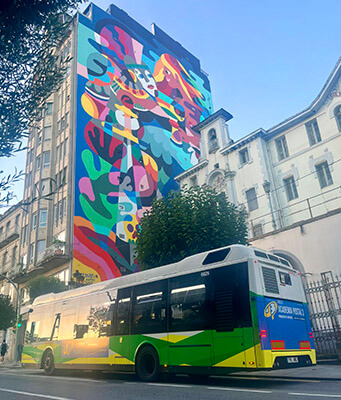 Vigo was a revelation: grand boulevards, excellent buses (right) and two very different railway stations – one with the character of Birmingham Moor Street, the other a vast New Street-style shopping complex with the railway tucked underneath.
Then came the border crossing into Portugal. The trains were comfortable and beautifully designed, the scenery spectacular, and crossing the Ponte de Eiffel – effectively the Eiffel Tower turned on its side, carrying a railway over the River Miño – was extraordinary.
From Porto to Coimbra, the journey became much more local. The trains were busy, friendly and full of people who seemed completely accustomed to the beautiful landscape passing their windows.
I arrived in Coimbra just in time for my presentation. Someone asked whether I had encountered any problems on the way.
“Everything was brilliant,” I said. “Everything ran on time. Great international connections. Until I got to Coimbra.”
The final leg apparently required a taxi to climb the hill into the historic city centre. Had they not heard our mantra that 70% of journeys are under five miles, and that local transport should come first? As it happened, they had. The following day – 10 September – Coimbra launched a major expansion of its bus and Metrobus services, including improved connections from Coimbra-B station into the city centre. Incredible timing!
And it brought home the wider point. International rail doesn’t exist in isolation: we know that in the UK transport is the highest emitting sector, so in a climate emergency, every country needs to be pulling its weight across all modes.
There are encouraging examples across Europe. France has set ambitious targets for reducing transport emissions and increasing sustainable travel. Spain’s 2025 Sustainable Mobility Law puts measurable transport decarbonisation and sustainable mobility at the heart of national policy, and Portugal has increased rail journeys by 10% in a year, after introducing the brilliant ‘passe verde’: just 20 euros for monthly travel across the entire national rail network.
Britain, meanwhile, has a problem. Incredibly, in the white heat of this climate emergency, transport emissions actually increased in the latest recorded year. Road traffic increased too, with car traffic up 2.5% in 2025. At a time when we have just experienced another extraordinary summer of heat, that should be a wake-up call.
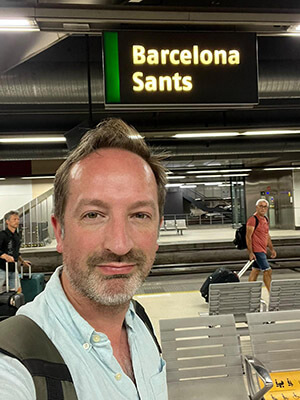 Government needs to get serious about changing the way we travel – not simply making the vehicles we use cleaner. Electric cars have an important role, but electrification alone cannot solve the transport problem. We need better public transport, more walking and cycling, and genuine alternatives to the car for everyday journeys.
As Andy Burnham recently put it, “we need to change the way we travel.” That is exactly the challenge. And there is an opportunity to join several things up.
If a hotter climate means more people want to avoid travelling to the hottest parts of the world for holidays, Britain should be ready to offer attractive alternatives. International rail can connect us to Europe without flying; domestic rail can connect people to Britain’s own beautiful cities and coastal communities. Places such as Blackpool and Scarborough should be part of that story. We should be investing in the transport that allows people to discover Britain without having to fly abroad or drive everywhere once they arrive.
The journey to Coimbra reminded me that better transport is not just about cutting emissions. It is about connecting communities, making places more attractive, giving people choices and making the journey itself part of the experience. We need to make international rail work better. We need to make domestic public transport work better. And, above all, we need to change the way we travel. That is how, I believe, transport can become part of the climate solution, rather than part of the problem.
Recent Posts
- From London to Portugal by train: what I learnt about transport and climate
- Car Free Day: imagining a less car-dependent future for children
- The heat is on: transport in a climate emergency
- Catch the Bus Month 2026: Busting Bus Myths
- You don’t need a car to have a great day out


