My Europe train holiday: Ten national borders, three sleeper trains, one big adventure!
Love train travel? Looking for inspiration for your next trip? You’ll enjoy this wonderful guest blog from our supporter, David Blainey, who spent his Europe holiday ‘living on trains’!
 “For the last two years, I have enjoyed exploring Europe by ‘living on trains’ for four or five days at a time! I appreciate that this way of travelling does not suit everyone, but it does demonstrate how Europe’s rail network successfully connects people and places.
The basis of my travelling is the marvellous ‘Interrail’ ticket, which was introduced in 1972 for under 21s. The scope and age covered has gradually expanded, until today this ticket covers 33 countries and all age groups. The pass I purchased gave me five days’ First Class travel over a month for £235.
Setting off…
This year I began my travels on foot, at 05:30 on the morning of 15th June, walking the 15 minutes to our local bus station, where I caught the first bus of the day to Chester. The bus’s audio ‘next stop announcement’ continually declared ‘The next stop is (blank)’ for the whole hour’s journey to Chester… but fortunately I know where Chester Railway Station is, and I arrived there in good time for the 07:32 train to London. My itinerary plans always try to include alternatives, in case of problems or delays. But if this bus hadn’t turned up, it would have meant catching a later train from Chester, with a knock-on effect on the rest of my travelling. (This is an extreme example of how the public transport network is not made up of individual journeys but is a web of inter-connected trips, joining up people and places.)
One recent additional benefit of the Interrail pass is that it includes a journey within the UK on the first and last days of a trip. As I had a First Class pass, this meant that I enjoyed a complimentary Avanti breakfast on the journey to London. From Euston it is a short walk to St Pancras International, with plenty of time to go through the required checks and board the train to Brussels. I would cross ten national borders over the next five days and this was the only time I had to show my passport until I wanted to re-enter the UK on my way home. More free food on the Eurostar and then an easy change at Brussels onto the train to Amsterdam. With an Interrail ticket there are small supplements to be paid on a few services such as Eurostar. So I travelled via Schipol to avoid paying an additional cost for the direct Eurostar service to Amsterdam.
Views and adventures
In Amsterdam I had time to enjoy the waterfront and then walk to Dam Square and view the canals before returning to Amsterdam Centraal to catch the overnight train to Prague. ‘European Sleeper’ are a new open access entrant to the overnight train market with a commitment to develop new services connecting Europe by night. There is a certain romance about seeing the train pulling into the platform with memories of ‘Murder on the Orient Express’. That was somewhat tempered on this occasion because the train was an hour late, the only major delay of my holiday. However when I looked out of the window at six the next morning we were in the outskirts of Berlin and back on time. I looked out at the sights of the city as I enjoyed the complimentary breakfast (more free food) and then continued on to Prague with a scenic passage along the Elbe valley. You wouldn’t get views like that from a plane!
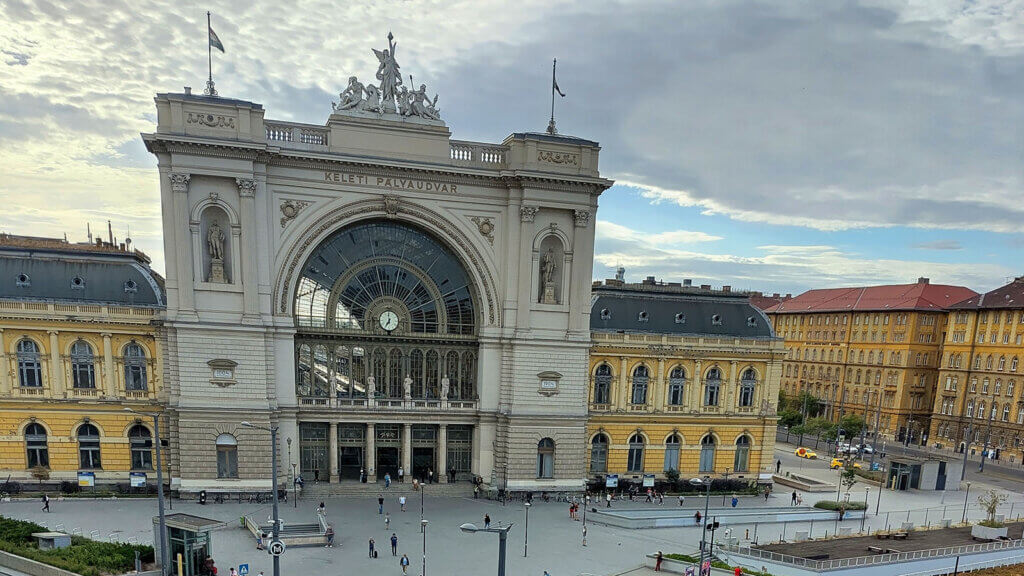
In Prague there was a quick change onto another train, for the seven hour journey to Budapest, where there are three main stations. I had to get from Nyuguti, where the Prague train terminated, to Keleti (pictured at the top of the page), where I was staying Tuesday night in a hotel (the only night of four in a building!). I needed to catch the 73 trolleybus, and I found a bus stop plate clearly marked. There was also a printed timetable sheet on the stop, with an indication of how long the journey would be. Over 65s of any nationality travel free in Budapest, so I didn’t have to worry about how to pay. And the trolleybus had a ‘next stop audio visual announcement’, which showed the next five stops, so it was easy to know when to get off. After checking into the hotel, I caught the Metro down to the river, to have a walk along the ‘beautiful blue Danube’. It was certainly beautiful, although not very blue! Like most European cities and major towns, Budapest has an extensive tram system as well as the Metro.
On Wednesday morning I caught the train from Keleti Station to Vienna, and from there had an ‘out and back’ ride on the amazingly scenic Semmering line to Graz. The line is a UNESCO world heritage site, but will soon be bypassed when the Semmering Base Tunnel opens in the near future. Although this will be good for the economics of long distance freight transport, hopefully the old line will remain open for some passenger trains, in the same way that it is still possible to travel on the old Gotthard line in Switzerland after the opening of the Gotthard Base Tunnel.
I don’t think there is another railway station in the world to compare with Venice Santa Lucia.
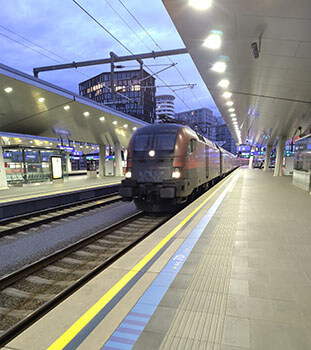 From Vienna I caught another sleeper (pictured right), this one operated by Austrian Railways, to Venice. I don’t think there is another railway station in the world to compare with Venice Santa Lucia (pictured at the bottom of the page). You walk out of the station and are on the bank of one of the main canals, teeming with all sorts of river craft. Everything that elsewhere would be carried by ‘white van’, in Venice is carried by boat. I had time to explore the city, at one time becoming concerned that I was lost in the maze of narrow streets and passages and dead ends..! But I made it back to the station, with time to sit by the canal, out of the sun, and watch the boats dash by. I was approached by a local man who was very curious about me and my big rucksack. He asked to be photographed with me, to remind him that, when he is as old as I am, he intends to do what I was doing! He was one of a number of interesting people I connected with on my travels.
On the Trenitalia high speed trains in Italy it is necessary to purchase a seat reservation, even with an Interrail ticket. The modern train sped us to Milan, with more English spoken than Italian. It was a really hot day and the air conditioning on all trains was really welcome. From Milan I caught one of the regular trains to Locarno in Switzerland, and began to see some of the wonderful Alpine scenery. Lake Como was a particularly popular destination for passengers. Locarno is the terminus of a narrow gauge line, the Centovalli Railway, which gives a direct connection from Locarno to Western Switzerland through Italy. I managed to get a seat right at the front of the train, next to the driver! This gave me unbelievable views and a real appreciation of the engineering skills applied to building the line, which frequently balances on the edge of sheer slopes. As a resident of North Wales I won’t be popular for saying it, but I think the Centovalli Railway surpasses any of the narrow gauge lines in North Wales!
This gave me unbelievable views and a real appreciation of the engineering skills applied to building the line, which frequently balances on the edge of sheer slopes.
I was now heading for home – Domodossalla (on the border of Italy and Switzerland) to Brig, and then a fast double-deck train from Brig to Zurich, to catch the overnight train to Cologne. From Cologne back to Brussels, with German Railways, and then Eurostar back to London. By now it was really warming up and we were asked on the Eurostar train to keep all window blinds down to keep the heat out. With nothing to look out at, it was rather like flying, but I was able to reflect on all the wonderful scenery I had seen in my adventure around Europe.
What had I learnt?
Europe has a wonderful railway network connecting every major centre, which then has links to smaller settlements. But the UK’s link to that network is tenuous, and requires passengers to arrive at St. Pancras at least 75 minutes before departure. If ‘through trains’ were operated it would be possible to do:
- Manchester to Paris in 4 hours
- Manchester to Brussels in 4 hours
- Birmingham to Cologne in 5 hours
All of these journeys would be time competitive with flying.
For many people, trying to use public transport in UK is like negotiating a foreign language, and they are provided with minimal information at the locations they are using and in the vehicles they travel on.
I was visiting Budapest for the first time, with no knowledge of the local language, and I needed to make a local bus journey. All the information I required was provided at the bus stop, and on the bus there was accurate, easy to understand, ‘next stop’ information. This made using the system easy and reassuring.
On many European trains, on the approach to stations, the information screens gave not only times of connecting trains but also of connecting buses. Something else that could be adopted more in the UK.
We have a lot to learn from our European friends.
Try the train!
Often the assumption is that flying or driving are the only options for international journeys, with all the negative implications of those choices. But Europe has a rail network that has the potential to connect the UK with cities and towns across the continent.
I would encourage everyone to consider using the train for their next trip into Europe! It is a perfectly viable alternative to flying, with at least two major advantages:
Firstly, an almost incredible reduction in CO2 emissions:
- A short haul flight produces 151g of CO2 per passenger kilometre
- Eurostar produces 4g of CO2 per passenger kilometre.
And secondly, railway passengers can have a much richer experience of the journeys to their chosen destinations, and even make the journeys themselves the main purpose of their travels and adventures – as I did!”


