“Residents feel isolated” – campaigning for better buses in Glossopdale
A group of local residents in Glossopdale, Derbyshire, have come together to improve public transport. In this guest blog, Karen Smith of Glossopdale Action for Sustainable Travel explains how they helped make sure that local voices were heard.

 “Glossopdale is situated in the far north west corner of Derbyshire, a couple of miles from the border with Greater Manchester to the West, and close to the Peak District National Park to the East. Glossopdale is made up of the town of Glossop (population ~22,000) and adjacent villages. Like many parts of the country, the private car currently dominates transport here. We have a train line to Manchester and buses serving a limited number of destinations. We have only one Sunday bus service (into Greater Manchester) which is also our only evening bus service.
In 2022, a group of local residents in Glossopdale came together to improve public transport and active travel. We formed Glossopdale Action for Sustainable Travel (GAST), supported by Helen Thornhill, the co-ordinator of Move More Glossop.
The GAST bus group surveyed local residents about their views and experiences of bus services in the area. The survey had both paper and online formats and was publicised via street stalls in central Glossop, at bus stops, on social media, and via Move More Glossop. We surveyed anybody who wished to repond, and not just those who use the bus services. One of the most important questions we asked was why people did not use the bus service.
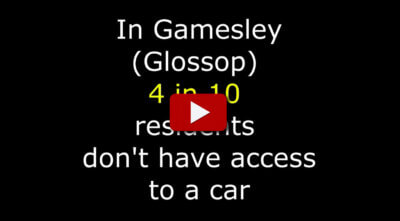
Analysis of the survey revealed that there was an area of town which was particularly hard hit by the lack of a decent bus service: the area of Gamesley. Due to it’s geography, Gamesley is fairly cut off from the town and the rest of Glossopdale. It has a population of approximately 3,000 residents, and the majority of the homes are on an estate made up of social housing. It has no access to buses on a Sunday or past 6.30pm in an evening. About one third of the residents do not have access to a car.
Poor bus services mean that residents cannot access essential services – students are late to school/college, patients miss hospital appointments…
Gamesley is classed as the most deprived area in the High Peak area of Derbyshire, and in the most deprived 10% of areas nationally (Ministry of Housing, Communities & Local Government, English Indices of Deprivation 2019). A recent Derbyshire County Council community needs assessment found that transport is a major barrier to the health and wellbeing of Gamesley residents. Poor bus services mean that residents cannot access essential services – students are late to school/college, patients miss hospital appointments, employment and training opportunities are limited, and it’s difficult to access shops for fresh food.
Our group set about consulting residents about the specific problems that they face due to lack of public transport, and the changes that they would like to see. We stood outside the shop, chippy, and infant school to interview residents for a video to send to councillors, council offficials, and our MP. Alan Simpson – East Midlands Sustainable Transport Ambassador – picked up on this and encouraged us to make a case to Mayor Claire Ward for specific changes to improve bus services for Gamesley, ahead of her revised commissioning of services.
As part of this, we made another video, interviewing residents at Gamesley Community Centre, and around the estate. This time we got permission to publish it on social media and other public outlets. We compiled a document summing up the issues and solutions put forward by residents. These ‘asks’ were basic: evening and Sunday services, more frequent and reliable buses, a bus for the secondary school and 6th form college, and a direct bus to the local hospital. Changes to existing bus services would fulfil all of these asks. The bus routes affected are cross border services with Greater Manchester, so we also sent the proposals to Andy Burnham (mayor of Manchester).
These ‘asks’ were basic: evening and Sunday services, more frequent and reliable buses, a bus for the secondary school and 6th form college, and a direct bus to the local hospital.
Many Gamesley residents feel isolated and even ‘abandoned’ by the lack of buses. They feel socially excluded and disconnected from other geographical areas. The changes they are asking for would promote social inclusion, make people feel more connected, and improve their mental and physical health. Every community and every person deserves this.
We are hopeful that our proposals, coupled with the ongoing petitioning and campaigning by Gamesley residents, will bear fruit. For the sake of local residents we hope it comes soon.”
Watch the brilliant video produced by the GAST bus group:
Recent Posts
- No stopping us now: making bus stops accessible for all
- From London to Portugal by train: what I learnt about transport and climate
- Car Free Day: imagining a less car-dependent future for children
- The heat is on: transport in a climate emergency
- Catch the Bus Month 2026: Busting Bus Myths


