What Germany’s €63 ticket can teach us about changing commuting behaviour
In this guest blog, Anna-Sophia Press from Statista+ crunches the numbers for Germany’s Deutschland ticket and answers the question, does cheaper and simpler public transport actually change how people travel day to day?

There’s a simple idea behind a lot of transport policy: if you make public transport cheaper, more people will use it. The question is whether it actually works like that in practice.
Germany’s Deutschlandticket is one of the clearest real-world examples we have. Introduced in 2023, it offers unlimited travel on local and regional public transport for a flat monthly fee (initially €49, now €63). No complicated fare structures, no regional boundaries to worry about – just one ticket that works almost everywhere.
It’s easy to see why the idea has attracted attention. Lower the cost, simplify the system, and you remove some of the biggest barriers to using public transport.
Looking at the numbers, the impact is clear. Commuters in Germany are estimated to save around €3 billion a year thanks to the ticket. But the more interesting question is what sits behind that number. Does cheaper and simpler public transport actually change how people travel day to day?
Looking at how people travel
To better understand the impact, Statista worked with the German Centre for Rail Traffic Research (DZSF) to analyse commuting behaviour across Germany. Survey data, official statistics and mobility datasets were combined to model a synthetic population of more than 40 million commuters.
This approach makes it possible to go beyond national averages and look at how behaviour changes across regions, distances and different commuter groups. That level of detail matters, because transport systems are experienced locally – not nationally.
The findings show that commuting in Germany is not static. In fact, the overall volume of commuting has increased in recent years, driven by a growing workforce, longer average commuting distances and the continued shift towards hybrid work patterns. People are travelling further, but not necessarily in the same way as before.
A shift, but not a sudden one
The ticket has made public transport more attractive. More people now use it for at least part of their commute, while car use has dipped slightly.
That matters. Price does influence behaviour.
But the shift is gradual. The car remains dominant by a wide margin. Cheaper public transport hasn’t overturned that – and that isn’t surprising. Travel habits are hard to change. People tend to stick with what works.
What people think things cost
Part of this comes down to perception. Driving often looks cheaper than it really is, because fixed costs like insurance or maintenance aren’t fully considered.
Public transport is judged differently. The ticket price is clear and immediate, and often fully attributed to commuting – even though it’s used for other trips too. So even when it’s cheaper, it doesn’t always feel that way.
It’s not just about price
Price is only one factor. Reliability, travel time and flexibility often matter more.
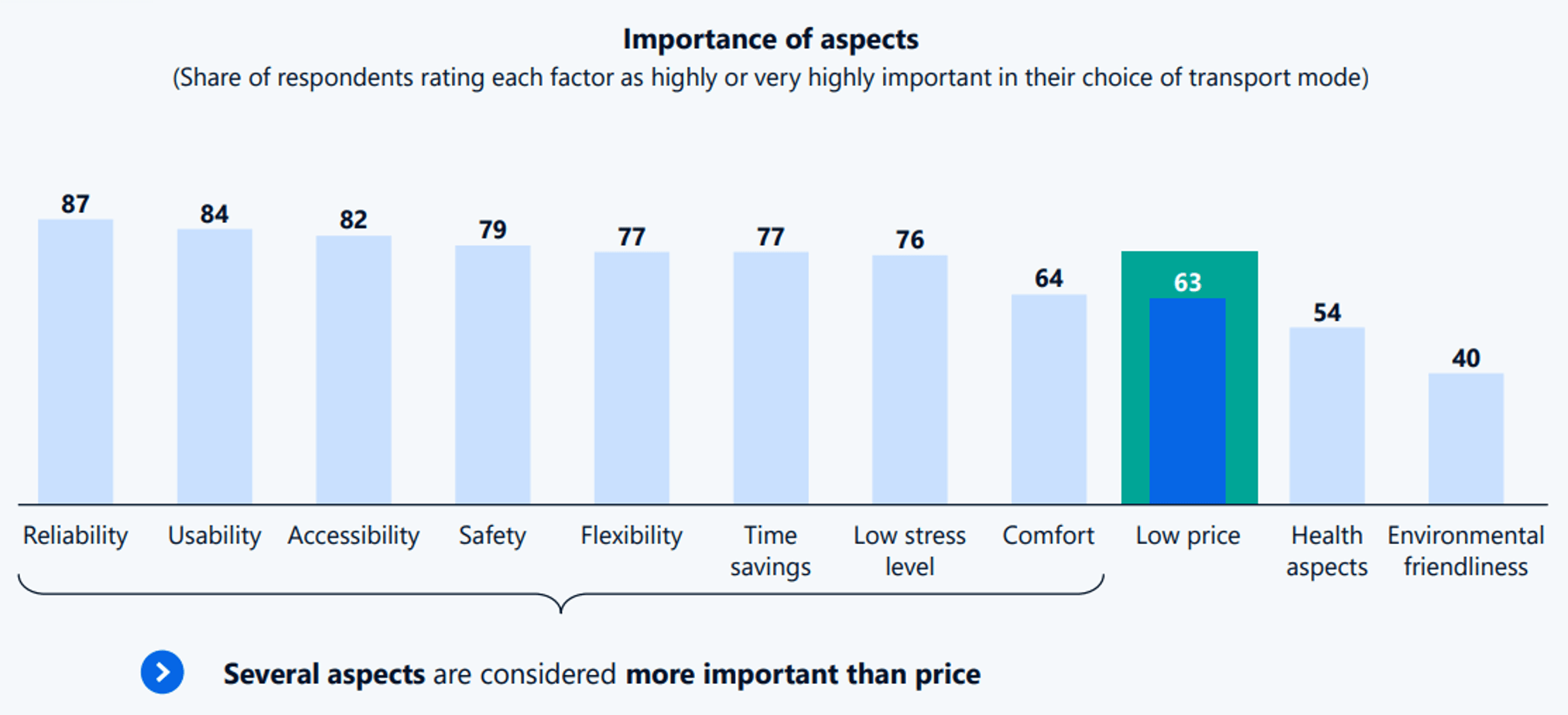
In many cases, the car still performs better on those fronts. That helps explain why lower prices alone don’t lead to a bigger shift. They make public transport more accessible – but not automatically the better option.
Where it makes the biggest difference
The effects are strongest in well-connected commuter regions around major cities, where public transport already offers a realistic alternative to driving. The map below shows where commuters using the Deutschlandticket saw the biggest savings compared with 2022. In many suburban districts around large urban centres, commuters were able to replace expensive local ticket subscriptions or reduce car use, leading to particularly noticeable savings.

Elsewhere, the impact is smaller. The ticket still reduces costs and supports combined journeys, but where services are limited, change is harder.
Affordable pricing can increase the use of a good network. It can’t compensate for a weak one.
Still some untapped potential
Adoption of the ticket has been high, but it’s used in different ways. Many regular users travel more often. At the same time, millions hold the ticket but don’t use it for commuting, relying on it mainly for leisure.
So there is still room for change – and in many cases, the remaining barriers seem to lie beyond price.
More of a starting point than an end point
The Deutschlandticket shows that simple, affordable pricing can make a difference. It lowers barriers and encourages more people to consider public transport.
But it also shows the limits of pricing alone. For a larger shift, public transport has to work in everyday life – reliable, convenient, and easy to use.
The ticket creates the conditions for change. How far that change goes depends on everything around it.
Read The cost of commuting and the influence of the Deutschland ticket, produced by Statista in collaboration with the German Centre for Rail Transport Research (DZSF.
Anna-Sophia Press is Business Development Director at Statista+


