We need better bus stops
Some bus stops are brilliant. The one in this picture – smart, sheltered, with comfy wooden seating, a clear screen telling you when the next three buses are due, and a machine for updating your Swift card – is a beauty. I’ll be paying it a visit next time I’m in Birmingham!

Photo: Journeo
But many bus users have a VERY different experience of bus stops. When researching for our new report, Better Bus Stops: Creating a national bus stop standard, we learnt that a shocking proportion of bus stops are poorly-equipped and lack even the most basic information.
- Only half of people surveyed for our report said their nearest bus stop has a shelter
- Only 31 per cent have an up-to-date timetable
- Just 16 per cent have access to live updates about bus arrivals.
Why does this matter? It matters because bus passengers – like Jay and Chrissy – deserve better.
My local bus stop is on the A23 and, after heavy rain, traffic whizzing past sprays water over waiting passengers. There’s no protection from the spray – there are no ‘ends’ at the bus stop, only a back and a roof.”
– Jay, bus user, South London
At the end of a walk I arrived in a village in the Peak District National Park, to find no times displayed at the bus stop. I tried calling Traveline to get the bus time. My phone had no signal so I stood waiting for a very long while in case a bus came along.”
– Chrissy, bus user, Derbyshire
But it also matters because better bus stops would tempt more people to use buses. In fact, in our survey, 47 per cent of people said that a good bus shelter would encourage them to use the bus more often, and a whopping 56 per cent said that having live updates about bus arrival times at the stop would get them using buses more.
Here’s an awesome fact: a study found that passengers who waited at stops with shelters, benches, and real-time arrival information for ten minutes perceived their wait to be 11 minutes, while those who waited at stops with no amenities perceived their ten-minute wait to be 21 minutes!
For the sake of the climate, clean air, and our clogged streets, we need to be doing all we can to make public transport attractive.
The solution: a national bus stop standard
Did you know, there’s a national standard for rail stations, meaning that even the least-used railway station in Wales, Sugar Loaf, used by fewer than eight passengers per week, has a working real-time information display and up-to-date paper-based information?
You guessed it: there’s no such standard for bus stops.
We say that needs to change. We are calling for a national bus stop standard, which would require all bus stops to provide a minimum level of facilities and information, based on their size. ALL bus stops should have:
- An up-to-date timetable on display
- Clear signage so people know the name of the stop and which buses they can catch there.
All apart from small ‘hail and ride’ stops should have:
- A real-time bus information display
- A covered shelter with seating.
You can find out about the other requirements we’re calling for in our report, Better Bus Stops: Creating a national bus stop standard, supported by Trueform.
Brilliant bus stops
While there’s much that is disheartening about the state of British bus stops, we also discovered some brilliant examples of best practice when researching our report, many of them recommended by our supporters. Here are three of the best…
This bus shelter at the University of East Anglia has a striking design, good signage and a clear real-time information screen… oh, and a swing to sit on while you wait!

Photo: LSI Architects
Partick Interchange in Glasgow has attractive, well-lit bus shelters, fully protected from the weather so you can wait for the bus in comfort.

Photo: Trueform
This new bus stop in Dunstable has wireless phone charging, bike parking, wide entrances for wheelchair users and a planted ‘green roof’. Its real-time displays include one with voice announcements to help guide visually impaired people.
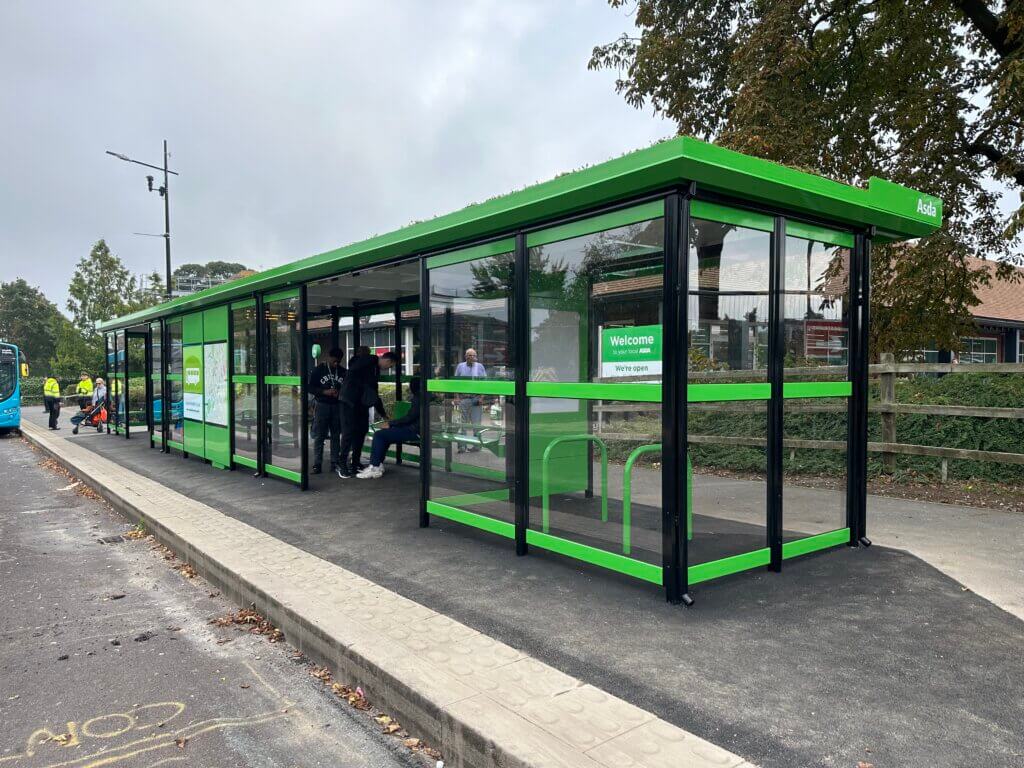
Photo: Externiture


