Fifty organisations write to PM about transport and climate change
Fifty organisations and academics from across the transport, environmental, climate, health and civic sectors have urged the Prime Minister to maintain the UK’s EV target, and to set out a more ambitious plan for tackling transport emissions. This is their letter:
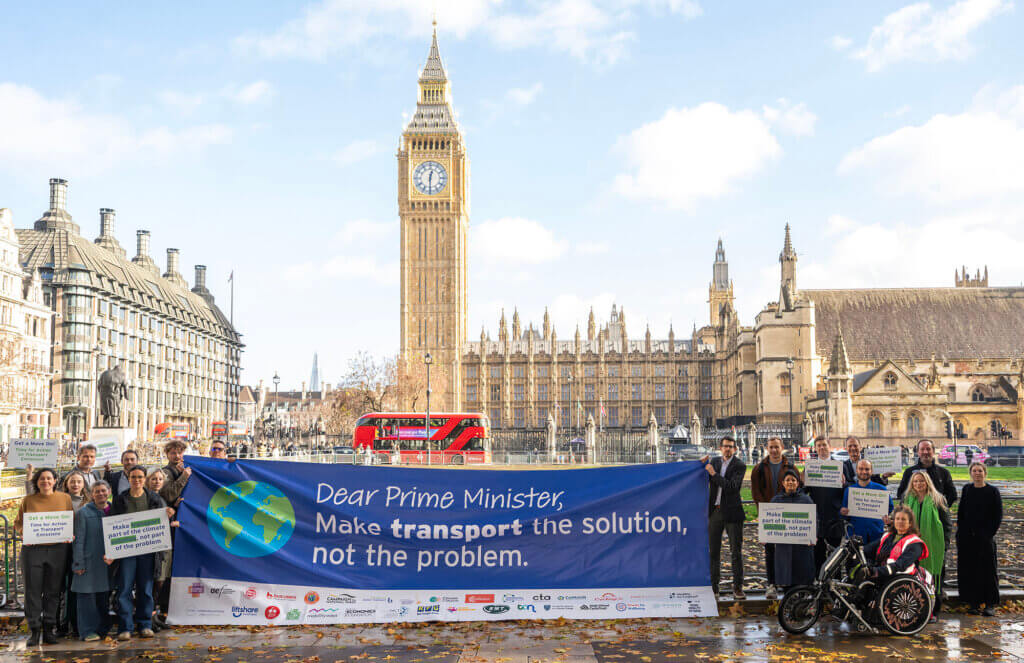
Dear Prime Minister,
As COP31 concludes, we are writing to urge the Government to maintain a strong and predictable Zero Emission Vehicle (ZEV) mandate, and to set out a more ambitious plan for tackling transport emissions. The transition to electric vehicles is essential, and the ZEV mandate provides vital certainty for manufacturers, investors and the wider supply chain. Weakening it would risk undermining progress towards decarbonisation at precisely the moment when we need to accelerate it.
As the Secretary of State for Energy and Net Zero has emphasised this week, the “drive for electrification…is a huge global opportunity… [T]hrough the roll-out of solar energy, batteries, clean heat and electric vehicles, communities in Britain will directly benefit from this energy transition”. The Climate Change Committee has also made clear that weakening the ZEV mandate would put the Government’s commitment to tackling climate change at risk, miss an opportunity to reduce household costs, increase the UK’s exposure to volatile oil markets, and damage long-term competitiveness.
The ZEV mandate is absolutely critical, but road transport electrification will not be enough on its own to deliver decarbonised transport or tackle the wider impacts of traffic. Meeting our climate commitments will require more than changing the vehicles we drive: it means making it easier, more affordable and more attractive for people and businesses to choose to travel by public transport, rail, shared mobility, walking and cycling. This is also an opportunity to create healthier communities, reduce household transport costs, improve access to opportunity as noted in the Milburn report and support thriving town and city centres.
Transport is the largest source of greenhouse gases in the UK economy, but it is also the only major sector in which emissions increased – by two per cent – between 2024 and 2025. This trajectory simply must change. We are therefore writing as organisations from across the transport, environmental, climate, health and civic sectors to urge the Government to stay committed to the ZEV mandate and to set out a credible, measurable plan for reducing transport emissions year on year. This means we must change not just the vehicles we use, but also crucially ‘change the way we travel’, as you have yourself recognised. That change is essential if we are to meet our climate commitments and meet wider social and economic goals.
National targets have been set across other policy areas such as housebuilding and NHS waiting lists. In transport, we have the active travel target for 55 per cent of local journeys to be walked, wheeled or cycled by 2035 and the rail freight growth target of a 40 per cent increase by 2040. The Government must now broaden this approach to include public transport and shared mobility. When in opposition, Labour’s Getting Britain Moving plan promised to ‘set targets for modal shift to lower emissions from the transport sector’. We now ask that you fulfil that promise.
We therefore call on the Government to introduce the following measures:
- Maintain the Zero Emission Vehicle (ZEV) mandate: Retain the existing ambition and trajectory of the ZEV mandate, providing the certainty manufacturers, investors and the wider supply chain need to accelerate the transition to electric vehicles.
- Set a clear, measurable trajectory for reducing transport emissions, with annual milestones and transparent reporting. Transport policy and investment must be aligned with that trajectory.
- Set national targets for increasing journeys people choose to make by sustainable transport, such as those set in France, Spain and Ireland, and as promised by Labour in opposition in 2024.
- Prioritise accessible public transport, shared mobility, community transport and active travel, shifting investment from new road building to sustainable transport to ensure that investment decisions are consistent with the UK’s climate commitments.
- Ensure car club and car sharing strategies are fast-tracked to increase car occupancy, saving people money and reducing congestion.
- Prioritise freight and passenger rail with both treated as vital to achieving emissions reductions and wider social and economic benefits.
- Align national carbon reduction plans with local targets in Outcomes Frameworks, supporting local leaders to use Better Connected to plan transport and new development around reducing carbon pollution and meeting the needs of their communities.
Other countries are showing that it is possible to introduce measures to reduce transport emissions by increasing sustainable transport use. The Welsh transport strategy states that modal shift is at its heart and sets a target of increasing public transport and active travel journey share from 32% to 45% by 2040. France has set a target of increasing rail use by 25 per cent by 2030, and along with reducing domestic aviation and empowering local leaders, emissions from transport have been coming down. Spain passed a Sustainable Mobility Law in 2025 with mode shift and traffic reduction embedded, and is requiring all large employers to report on their travel plans twice a year, while the Republic of Ireland has targets to increase daily public transport journeys by 130% and active travel journeys by 50 per cent by 2030. Better Connected, the national strategy for integrated transport for England, has no such targets. This must be rectified if emissions are to come down.
We are calling for a clear outcome: transport emissions must fall, and government policy and investment must be aligned with delivering that outcome. This is not a risk, but a positive opportunity to improve people’s everyday journeys by widening travel choices and thereby reduce congestion, create prosperity in every postcode, alleviate social exclusion, and support healthier communities.
We urge you and your Cabinet colleagues to commit to reducing emissions from transport and to set out the actions that will deliver this and wider societal benefits. As the highest emitting sector, transport has been the problem. The time has come for it to be the solution.
Yours sincerely
- Ben Plowden, CEO, Campaign for Better Transport
- Dave Calfe, General Secretary, ASLEF
- Jonathan Blades, Head of Policy and Public Affairs, Asthma and Lung UK
- Tim Johnson, Director, Aviation Environment Federation
- Lydia Horbury, Chief Executive, Bus Users UK
- Claire James, Campaigns Coordinator, Campaign against Climate Change
- Ruth Bradshaw, Head of Policy and Research, Campaign for National Parks
- Noel Dolphin, Director, Campaign to Electrify Britain’s Railways
- Oliver Lord, UK Director, Clean Cities
- Kyle Lischak, Head of UK, ClientEarth
- Emma Richardson, Head of Policy & Research, Climate Catalyst
- Isaac Beevor, Partnerships Director, Climate Emergency UK
- Zoe McAlpine, CEO, Climate Outreach
- Chris Birks, Director of Policy and Communications, Community Rail Network
- David Kelly, Head of Policy and Campaigns, Community Transport Association
- Richard Dilks, Chief Executive, CoMoUK
- Steve Brooks, Director of External Affairs, Cycling UK
- Thomas Ableman, Founder, Freewheeling
- Rosie Downes, Head of Campaigns, Friends of the Earth
- Catherine Kenyon, Head of Clean Air, Global Action Plan
- Louise Dando, CEO, Good Journey
- Mike Davis, CEO, Green Alliance
- Claire Haigh, Founder & CEO, Greener Vision
- Dr Camilla Kingdon, Chair, Healthy Air Coalition
- Aruna Sivakumar, Professor of Demand in Urban Systems, Imperial College London
- Jo Field OBE, Founder & Chief Executive, JFG Comms
- Tanya Braun, Director of External Affairs, Living Streets
- Tom Fyans, Chief Executive, London Cycling Campaign
- Ali Clabburn, Chairman, Mobilityways Ltd and Liftshare.com Ltd
- Nick Butler, Chief Executive Officer, Modeshift
- Jemima Hartshorn, Director, Mums for Lungs
- Danny Sriskandarajah, CEO, New Economics Foundation
- Jamie Hassall, Executive Director, PACTS
- Ruth Gelletlie, Chair, Partnership for Active Travel, Transport and Health
- Hirra Khan Adeogun, Co-Director, Possible
- Eddie Dempsey, General Secretary, RMT
- Elaine Clark, Chief Executive, Rail Forum
- Maggie Simpson, Director General, Rail Freight Group
- Leo Murray, CEO, Riding Sunbeams
- Dr Mark Harber, Royal College of Physicians Special Adviser on Healthcare Sustainability and Climate Change
- Tim Dexter, Interim Director, T&E UK
- Abby Coften, CEO, Transport Action Network
- Christopher Hammond, CEO, UK100
- Professor Hugh Montgomery OBE FMedSci, Chair, UK Health Alliance on Climate Change
- Rosa Foster, Climate Commissions Director, University of Leeds
- Greg Marsden, Professor of Transport Governance, University of Leeds
- Kate Pangbourne, Professor of Transport Transitions, University of Leeds
- Paul Twocock, Executive Director, Strategy and Engagement, Walk Wheel and Cycle Trust
- Isabelle Clement MBE, Director, Wheels for Wellbeing
- Sonya Byers OBE, CEO, Women in Transport
- Anna Filby, CEO & Founder, Young Mobility Network UG
Recent Posts
- Fifty organisations write to PM about transport and climate change
- Tunnel vision: unlocking the potential of international rail
- Safer journeys for women and girls
- No stopping us now: making bus stops accessible for all
- From London to Portugal by train: what I learnt about transport and climate